
 135-6073-0094
PRODUCT CENTER
Cutting Tool Screws
Spring-loaded ball plungers with a spherical tip for locatin
Ball-Nose Set Screws | M4 Spherical Contact Positioning Screws
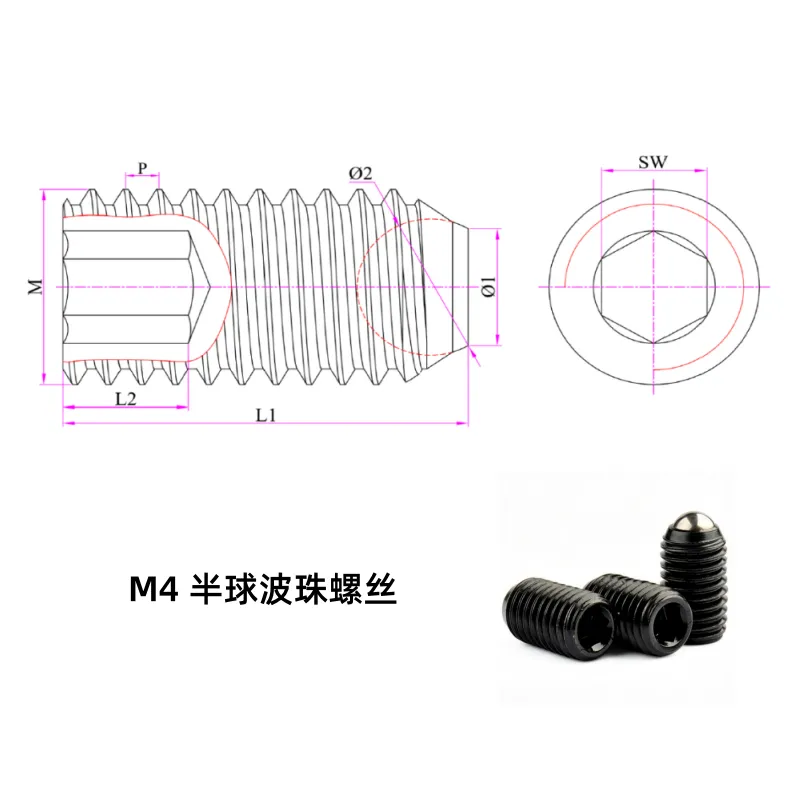
- Size rangeM4
- MaterialSCM435 steel (stainless ball optional)
- FinishBlack oxide, zinc-nickel
- Installationadjusted with a hex key
- StandardGB/T 3098.1, GB/T 197
- Typical substratefixture location, stops, light clamping
Product overviewOverview
A ball plunger encapsulates a steel ball at the tip of the screw, backed by a spring. The ball contacts the workpiece at a point: contact stress is high but the footprint is small, which suits detents, stops and clamping that needs a little compliance. The spherical tip also lets the force direction adapt to the surface angle, reducing side load.
This page covers M4 in SCM435 steel (stainless ball optional), with black oxide, zinc-nickel as the standard finish.property class 12.9; installed by adjusted with a hex key.
Key featuresFeatures
- Spherical tip gives point contact with minimal marking on finished surfaces.
- Internal spring provides travel to absorb tolerance and thermal movement.
- Hex socket allows the holding force to be trimmed after assembly.
- Ball in stainless or bearing steel, retained by a staked front edge.
Typical applicationsApplications
- Fixture locating and stops
- Mould parting-line detents
- Workpiece clamping on automation
Selection notesSelection
Match spring rate to the holding force needed: too stiff dents thin walls, too soft gives an unstable location.
Frequently asked questionsFAQ
How do I specify the Ball-Nose Set Screws | M4 Spherical Contact Positioning Screws?
What matters during installation of the Ball-Nose Set Screws | M4 Spherical Contact Positioning Screws?
| Size range | M4 |
|---|---|
| End type | Spherical ball |
| Material | SCM435 steel (stainless ball optional) |
| Property class | 12.9 |
| Finish | Black oxide, zinc-nickel |
| Standards | GB/T, ISO |
| Standard | GB/T 3098.1, GB/T 197 |
| Installation | adjusted with a hex key |
| Typical substrate | fixture location, stops, light clamping |
| Key inspections | ball retention, spring travel, thread gauging |
Ball diameter, protrusion and seating depth are sampled optically.We recommend a pilot assembly at the actual torque and mating part before locking the process parameters for volume.