
 135-6073-0094
PRODUCT CENTER
Locking Products
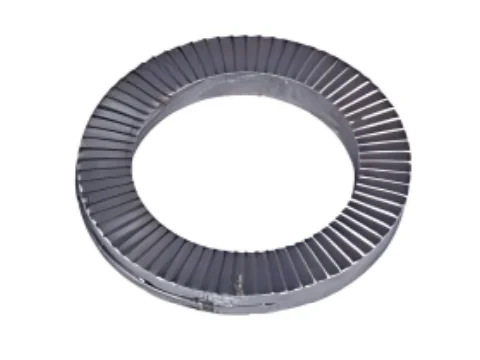
Two-piece wedge-lock washer: a cam angle steeper than the th
Wedge-Lock Dual-Layer Washer
- MaterialSpring Steel 65Mn
- Installationfitted as a pair with cams facing
- StandardGB/T 94.1, ISO 16130 (transverse vibration)
- Typical substratewind, construction and rail structures
- Key inspectionstooth height, hardness, locking performance
Product overviewOverview
Conical washers instead use a dished spring form to maintain clamp force and compensate relaxation, while double-toothed washers rely on tooth bite for anti-rotation. The facing sides of the pair carry radial cams and the outer faces carry gripping serrations. For the bolt to back out, the cams would have to climb, and climbing needs more axial movement than the thread can give at that rotation, so the bolt is held.
Material: Spring Steel 65Mn. The two washers are fitted as a pair with the cams facing each other.
Key featuresFeatures
- Cam angle exceeds the thread lead angle, so the pair cannot back out.
- Cam geometry converts loosening into axial lift, so locking is independent of friction.
- Must be used as a pair with cams facing each other; a single washer provides no locking.
- Conical washers maintain clamp force where thermal cycling relaxes the joint.
Typical applicationsApplications
- Automotive chassis and driveline
- Pressure vessels and pipe flanges
- Wind turbine towers and nacelles
Selection notesSelection
Always fit as a pair with cams facing each other and serrations against the part and the head; a single washer has no locking function.
Frequently asked questionsFAQ
Why must the two washers be used as a pair?
What matters during installation of the Wedge-Lock Dual-Layer Washer?
| Material | Spring Steel 65Mn |
|---|---|
| Surface Treatment | Black oxide / Zinc-plated |
| Standard | GB/T 94.1, ISO 16130 (transverse vibration) |
| Installation | fitted as a pair with cams facing |
| Typical substrate | wind, construction and rail structures |
| Key inspections | tooth height, hardness, locking performance |
Tooth height, cam angle and hardness are sampled to drawing.We recommend a pilot assembly at the actual torque and mating part before locking the process parameters for volume.